


Success Story: A Journey from Vulnerability to Hope
Beneficiary: Uma Kunwar
Age: 30 years
Address: Babai Rural Municipality–5, Hurum Gauje, Dang District
Uma Kunwar, a 30-year-old woman from the remote village of Hurum Gauje in Babai Rural Municipality–5, earns her family’s livelihood through goat rearing and subsistence farming. When the PRERANA Project’s SATH Program, implemented by the Nepal Women Community Service Center (NWCSC), was launched, Uma was already pregnant with her first child.
Due to time constraints during the initial implementation phase of the SATH Program, the project team was unable to fully assess her living conditions. Later, with the support of the Female Community Health Volunteer (FCHV), a home visit was conducted to better understand her situation.
The visit revealed an extremely distressing reality. Uma and her family were living in a small, fragile hut under very poor sanitary conditions. Garbage was scattered around the house, and the family lacked even basic food supplies such as rice, lentils, and vegetables. Her husband was heavily addicted to alcohol and was found unconscious due to excessive drinking.
More alarmingly, despite being seven months pregnant, Uma had not received any antenatal care (ANC) check-ups. Because of severe physical weakness, she was unable to walk to a health facility on her own. The local FCHV had managed to accompany her for only two antenatal check-ups.
After witnessing the family’s situation firsthand, the PRERANA Project staff spent considerable time counseling Uma’s husband about the importance of maternal health, nutrition, and his responsibilities toward his wife and unborn child. The discussion had a significant impact on him. He promised that, if necessary, he would even sell one of their goats to ensure that Uma received proper medical care, including the recommended health examinations and ultrasound services.
Fifteen days later, during a follow-up visit, the project team found that he had fulfilled his commitment. He had sold a goat and used the money to take Uma for a comprehensive maternal health check-up and ultrasound examination.
Although the family lived in a remote settlement without road access, making transportation impossible, Uma went into labor at night before she could be taken to a health facility. As a result, she delivered her baby safely at home.
Today, both Uma and her baby are healthy and doing well.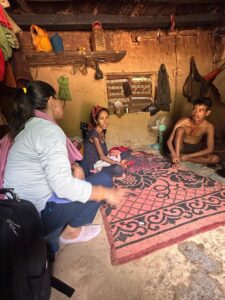
Uma’s story demonstrates that timely identification of vulnerable families, compassionate home visits, personalized counseling, and close collaboration with Female Community Health Volunteers can bring meaningful behavioral change even in the most challenging circumstances. While geographical barriers continue to limit access to institutional delivery in remote communities, the PRERANA Project has shown that community-based interventions can significantly improve maternal health awareness, family support, and healthcare-seeking behavior, ultimately contributing to better outcomes for mothers and newborns.